
Current issue contents
We usually post one article per issue, usually after a delay of several weeks.
Subscribe today, and spare yourself the long wait for only partial satisfaction!
Issue #134 was published in February 2012.
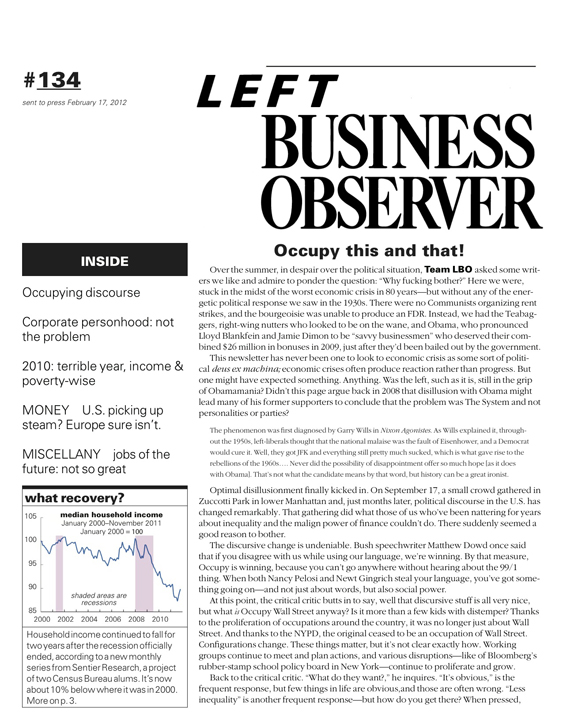
occupying discourse • corporate personhood: not the problem • 2010: terrible year, income & poverty-wise • U.S. picking up steam? Europe sure isn't • jobs of the future: not so great
a little taste of each...
Over the summer, in despair over the political situation, Team LBO asked some writers we like and admire to ponder the question: "Why fucking bother?" Here we were, stuck in the midst of the worst economic crisis in 80 years—but without any of the energetic political response we saw in the 1930s. There were no Communists organizing rent strikes, and the bourgeoisie was unable to produce an FDR. Instead, we had the Teabaggers, right-wing nutters who looked to be on the wane, and Obama, who pronounced Lloyd Blankfein and Jamie Dimon to be "savvy businessmen" who deserved their combined $26 million in bonuses in 2009, just after they'd been bailed out by the government.
This newsletter has never been one to look to economic crisis as some sort of political deus ex machina; economic crises often produce reaction rather than progress. But one might have expected something. Anything. Was the left, such as it is, still in the grip of Obamamania? Didn't this page argue back in 2008 that disillusion with Obama might lead many of his former supporters to conclude that the problem was The System and not personalities or parties?
The phenomenon was first diagnosed by Garry Wills in Nixon Agonistes. As Wills explained it, throughout the 1950s, left-liberals thought that the national malaise was the fault of Eisenhower, and a Democrat would cure it. Well, they got JFK and everything still pretty much sucked, which is what gave rise to the rebellions of the 1960s…. Never did the possibility of disappointment offer so much hope [as it does with Obama]. That's not what the candidate means by that word, but history can be a great ironist.
Optimal disillusionment finally kicked in. On September 17, a small crowd gathered in Zuccotti Park in lower Manhattan and, just months later, political discourse in the U.S. has changed remarkably. That gathering did what those of us who've been nattering for years about inequality and the malign power of finance couldn't do. There suddenly seemed a good reason to bother.
The discursive change is undeniable. Bush speechwriter Matthew Dowd once said…
[...]
There was a witticism circulating—it embarrasses me a bit to say—on Facebook recently that went something like: “I’ll believe that coporations are people when Texas executes one.” I'm no fan of capital punishment, but that was the best argument in favor of corporate personhood I’ve ever heard. Because while corporations have the rights of actual living people—more, maybe—they have none of the responsibilities. Corporations routinely get away with murder. Is the problem that they're legally persons, or that they’re not consistently treated as such?.…
[...]
As the Census Bureau reported a few months ago, 2010 was not a bountiful year. Average household incomes were down for the third year in a row, and poverty was up for the fourth. Not only was 2010 a miserable year—it's been a miserable decade. In the eleven years since 2000, income has fallen and the poverty rate has risen in eight. We've never seen anything like this since modern statistics began. Next to that, the modest increase in the number of people without health insurance barely qualifies as news..…
[...]
In the half-eon since this page last appeared, the U.S. economy has occasionally given the appearance of finding firmer footing. In December, employers added 203,000 jobs, and then beat that by adding 243,000 in January. That was the best two-month performance since last spring—and before that, the previous spring, that of 2010. Before that, you'd have to go back to 2006 to find job gains that strong.
Having begun on that upbeat note, time to bring on the caveats...
[...]
Educate! Educate! The standard bourgeois prescription for our long-term economic woes is more education. Stagnant mass incomes and mind-boggling polarization? More college! Leaving aside the facts that half the population can't afford to go to college, and that if everyone went, any alleged advantage to having a degree would be reduced—would the better jobs be there? Not if the latest official prognostications are right....
[...]
Home Mail Articles Stats/current Supplements Subscriptions Links